How to Assemble a Corner Cabinet
Guide to Assembling Frameless Style 5/8″ Plywood Angled or Pie Corner Cabinets
This guide provides step-by-step instructions for assembling frameless corner cabinets made from 5/8″ plywood, utilizing screw and dowel joinery. You’ll also learn how to install drawer boxes with undermount soft-close slides and attach doors with concealed European soft-close hinges.
Tools and Materials Needed
Tools
- Electric drill or screwdriver
- 5mm drill bit
- Phillips head screwdriver
- Measuring tape
- Level
- Clamps
- Square
- Wood glue (optional)
- Rubber mallet
- Utility knife
- Safety goggles
Materials
- Cabinet parts (sides, top, bottom, back and shelves)
- Screws (included)
- Dowels (included)
- Drawer boxes (pre-assembled or flat-pack)
- Undermount soft-close drawer slides
- Cabinet doors
- Concealed European hinges
- Cabinet hardware (handles, knobs)
Step 1: Prepare Your Workspace
- Choose a large, flat surface to work on. Make sure you have good lighting.
- Unpack the cabinet components and verify you have everything based on the parts list. Encore Cabinets packages all the cabinet box parts for each cabinet together for easy organization. Doors, Drawer Fronts, Drawer Boxes and Hardware are packaged separately for maximum protection.
Step 2: Assemble the Cabinet Frame
Assemble Back Left Panel to Top
- Locate the Dowels: Place the Corner Thick Back Left panel on a work bench or the floor. Note that it will be inset ¼” so setting on some blocks might be helpful. Locate the dowels on the top end.
- Align the top Panel: Apply wood glue to the dowels (optional). Align the top panel with the dowels.
- Secure the Panels: Ensure the panels are secure by fastening them together with screws.
Attach Corner Back Angled Notch and the Corner Thick Back Right Side Panel
- Locate the Dowels: Locate the dowels on the top of the Corner Back Angled Notch and the Corner Thick Back Right panels.
- Align the Corner Back Angled Notch and the Corner Thick Back Right Panels: Apply wood glue to the dowels (optional). Align the dowels in the Corner Back Angled Notch and the Corner Thick Back Right panel with the holes in the top panel.
- Secure the Panels: Ensure the panels are secure by fastening them together with screws.
Attach Bottom of Cabinet to Back
- Locate the Dowels: Locate the dowels on the bottom of the back panels.
- Align the Bottom Panel: Apply wood glue to the dowels (optional). Align the Bottom Panel with the dowels from all 3 Back Panels.
- Secure the Panels: Ensure the panels are secure by fastening them together using screws.
Insert all Adjustable Shelves
- Place all adjustable shelves in the inside of the cabinet prior to applying the left side. All of the shelves can be stacked at the bottom of the cabinet during assembly.
Attach the Left Side Panel
- Locate the Dowels: Locate the dowels on the left side of the back, top and bottom panels.
- Align the Base Left Side Panel: Apply wood glue to the dowels (optional). Align the left side panel with the dowels on the back, top and bottom panels as well as the shelves if applicable.
- Secure the Panels: Ensure the panels are secure by fastening them together using screws.
Insert the Toe Kick (For Base Corner Cabinets only – For Wall Cabinets Skip to Attach Right Side Panel)
- Locate the Dowels: Locate the two toe kicks. Note that one of them has dowels on both sides and the other has only on the right side.
- Align the Toe Kick with dowels on both sides:
- Apply wood glue to the left side of the toe kick with dowels on both sides (optional).
- Align the left side panel with the dowels.
- Align the remaining Toe Kick:
- Apply wood glue to the dowels on the right side of the toe kick with dowels on both sides (optional).
- Align the remaining toe kick with the dowels.
Attach Right Side Panel
- Locate the Dowels: Locate the dowels on the right side of the top, bottom and back panels as well as on any shelves and on the toe kick (on base cabinets only).
- Align the Right Side Panel: Apply wood glue to the dowels (optional). Align the right side panel with the dowels. The cabinet can be flipped onto the left side panel to make this easier.
- Secure the Panels: Ensure the panels are secure by fastening them together using screws.
Install the Shelves (The remaining steps should be done after the cabinets are installed).
- Raise the shelves to desired height and install shelf pins under each shelf to hold it in place using the holes provided. Ensure the shelf is level and sturdy.
Step 3: Install Cabinet Doors
Prepare the Doors
- Identify the top and bottom of each door and where the hinges will be placed on the back. There will be holes pre-drilled in the back of each door for the hinges.
Install Concealed European Hinges
- Attach Hinges to the Door: Secure the hinges (also known as the hinge arm) in place with screws.
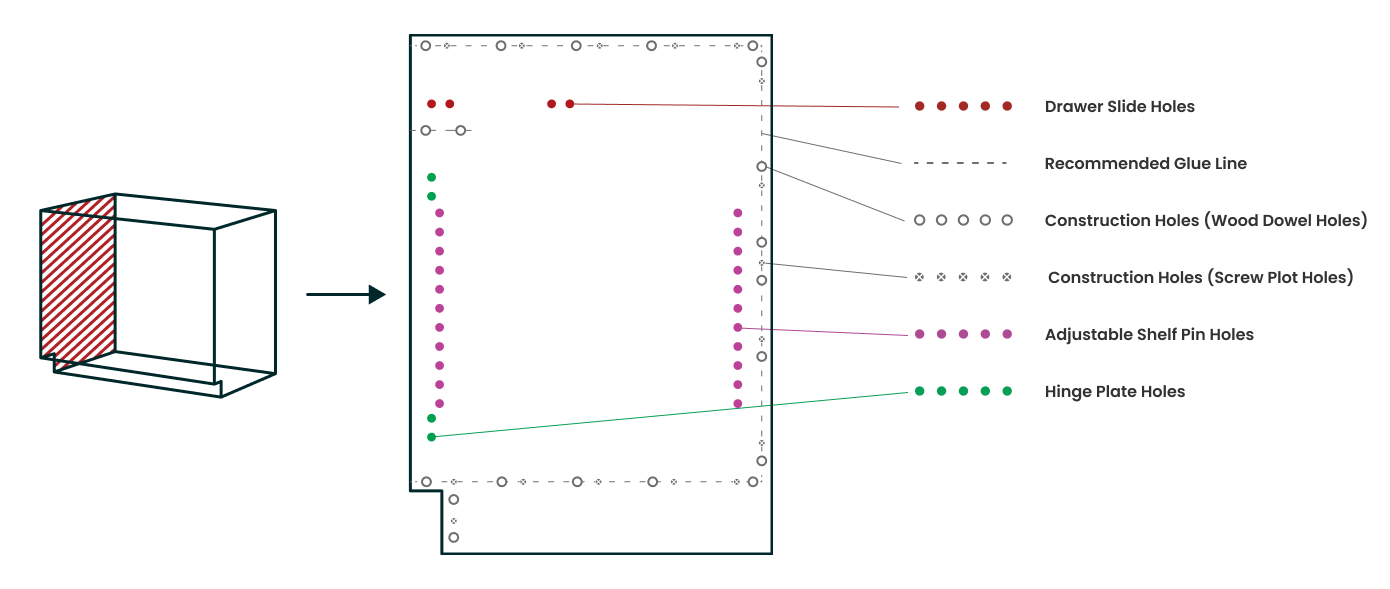
- Attach Hinge Plates to the Cabinet: Secure the hinge plates in place with supplied screws into predrilled holes. The hinge plate holes will be closer to the front of the cabinet than the adjustable shelf pin holes for easy identification. See Drawing 1. Ensure the plates are on the correct side to result in your desired door swing and are the correct height to line up with door hinges.
- Mount Hinges to the Cabinet: Position the hinge mounting post on the hinge arm against the front of the hinge mounting plate on the cabinet frame and push the back of the hinge arm against the cabinet frame. You will hear a click when attached.
Drawing 1
Adjust the Door
- Use the adjustment screws on the hinges to align the doors evenly.
Step 4: Finishing Touches
- Install Hardware: Attach handles or knobs to the doors.
- Check Level and Alignment: Use a level to ensure the cabinet is straight. Adjust if needed.
- Cleanup: Wipe down surfaces to remove any dust or debris from assembly.
Step 5: Final Inspection
- Open and close all drawers and doors to ensure smooth operation. Inspect for any loose screws or misalignments and make necessary adjustments.